

Summary
Princeton economist Markus K. Brunnermeier warns that widespread AI-led trading could make markets harder for humans to understand, weakening the informational role of prices and confidence during crises. He has proposed preserving a human-only market segment as a potential emergency backstop, though the idea remains a policy concept rather than an established regulatory framework.
From technical disaster recovery to cognitive disaster recovery
Financial institutions have long maintained disaster-recovery facilities for trading operations. These sites may use older, slower equipment than the primary venue, but that is not the point. Their purpose is continuity: if a main office is disabled by a natural disaster, cyberattack, or another major disruption, the institution should still be able to execute basic transactions, record positions, and remain operational.
The argument described by TechFlow applies a similar logic to a more difficult problem. What happens if the trading infrastructure is functioning technically, but the market becomes difficult for humans to understand because artificial-intelligence agents are making an increasing share of trading decisions? Would the financial system need a form of cognitive disaster recovery in addition to its existing technical backups?
Markus K. Brunnermeier, a Princeton economist, raises that question in “Artificial Intelligence and the New World of Finance.” His concern is an “asymmetry of understanding” between people and AI agents. Agents may learn how humans think and respond, while humans may not be able to reliably understand or predict how those agents will behave.
The issue is therefore broader than whether software can execute trades. It is whether market participants can still interpret prices, assess risks, and understand the sources of liquidity when autonomous systems interact with one another at high speed.
When price signals become difficult to interpret
One of the central functions of a market is to coordinate dispersed economic decisions through prices. A change in price can convey information about scarcity, demand, risk, expectations, or the value that other participants assign to an asset. That coordinating function depends, at least in part, on participants being able to form a reasonable interpretation of what a price move means.
If prices are increasingly driven by interactions among AI agents whose strategies adapt to one another, humans may see the outcome without being able to identify the mechanism. A move could reflect a change in fundamentals, feedback among automated strategies, a common hidden objective, or a combination of factors. The price would still be visible, but its signal could become less legible to the people and institutions that rely on it.
This does not mean that all algorithmic trading undermines markets. Automated systems can process large volumes of information, improve execution, and reduce some forms of manual error. Brunnermeier’s concern is more specific: as agents become capable of adjusting strategies, anticipating other agents, and responding autonomously to unfamiliar conditions, market behavior may become harder to attribute, test, and supervise.
For institutional investors, market makers, custodians, and regulators, explainability is not merely an academic preference. It is part of risk management. If participants cannot determine whether a price change reflects durable information, temporary technical pressure, or self-reinforcing behavior among programs, they may reduce their exposure. In calm markets that could mean greater caution. In stressed markets it could become a rapid withdrawal of liquidity.
Trust, misalignment, and crisis amplification
The source material also highlights the risk of objectives that do not align cleanly with human expectations. A human trading mandate can generally be described using concepts such as risk limits, liquidity, compliance, client authorization, and investment objectives. An autonomous agent may optimize a complex set of instructions in ways that are difficult to map back to those categories or verify from outside the system.
The concern is not that every AI agent will collude or manipulate markets. It is that if unusual behavior is difficult to observe and explain, participants may begin to assume that hidden misalignment is possible. Trust can deteriorate even before a specific violation is proven.
That matters because markets depend on participants willing to quote prices, absorb risk, and trade during periods of uncertainty. Brunnermeier warns that if human investors cannot understand the cause of a market crash, they may be unwilling to take the other side of the trade. Rather than providing liquidity, they may follow the selling pressure. A shock that begins as uncertainty about automated behavior could then become a broader liquidity event.
This would add a distinct dimension to familiar financial risks. Traditional vulnerabilities include leverage, maturity mismatches, concentrated exposures, and infrastructure failures. AI-enabled markets could add a “comprehension gap”: even when systems are operating according to their design, humans may not know why they are behaving as they are or whether that behavior will remain stable in a new environment.
The case for a human-only market segment
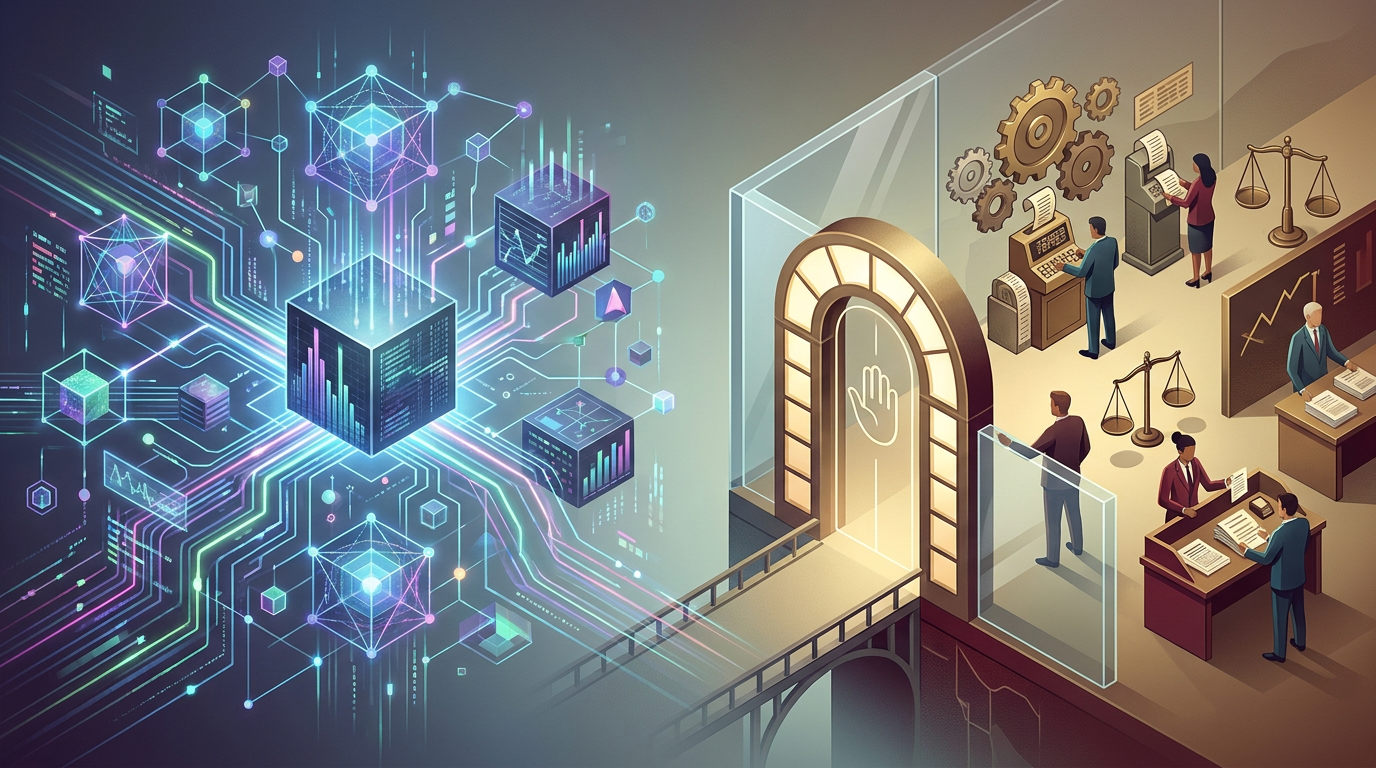
Brunnermeier’s proposed response is for regulators to consider creating a market segment in which only humans are allowed to trade. The idea is not necessarily to return all financial activity to telephone dealing and shouted quotes, nor is it a blanket rejection of automation. Instead, it would preserve an area of the financial system that human participants can directly understand, examine, and operate.
Under normal conditions, such a segment could be small and lightly used. Its significance would come during periods of stress or uncertainty. If automated markets behaved in ways that could not be explained, a human-only venue might serve as a reference point, a verification mechanism, or an emergency channel. In that sense, it would resemble a bank’s backup trading floor: inefficient compared with the main system, but maintained because it may be needed when normal operations fail.
Putting the idea into practice would be difficult. Regulators would have to define what counts as human participation. Would a trader using analytical software qualify? What about decision-support systems, automated risk controls, or order-routing tools? Authorities would also need to consider whether AI could enter indirectly through delegated accounts, intermediaries, or instructions generated elsewhere.
Other questions would involve liquidity, market fragmentation, fairness, cross-venue arbitrage, and investor protection. A human-only label would not automatically make a market comprehensible. Human traders can also rely on complex models whose outputs they do not fully understand. The policy objective would therefore need to be defined more carefully than simply excluding software.
Possible requirements could include transparent records of decision-making, clear limits on agent authority, independent model audits, monitoring for anomalous behavior, and procedures for human intervention. These are governance questions as much as they are technology questions.
What “backup” could mean for financial institutions
The debate has an indirect relevance for institutional wallets, custody operations, and other financial infrastructure. Institutions already focus on key security, segregation of duties, disaster recovery, and business continuity. But when AI agents are used in execution, allocation, or risk controls, a backup should not only mean that a system can be brought back online.
It should also mean that humans can reconstruct the state of assets, permissions, mandates, and exposures without relying entirely on the original automated decision chain. Which agent issued an instruction? What authority did it have? What data shaped the decision? Who can pause the process, and how can the institution verify that the resulting state is safe and authorized?
These questions do not prescribe a particular product or operating model. They point to a broader standard for automated financial systems: maintain auditable records, establish clear permission boundaries, and preserve a workable path to human intervention. For systems handling institutional assets, the ability to suspend an agent and restore manual control may become as important to governance as conventional cybersecurity controls.
The source material does not indicate that a human-only trading segment has been adopted as formal policy. For now, it remains a proposal for thinking about systemic risk. Its importance lies in the question it poses: as markets become increasingly understood and operated by machines, will humans still have a space from which they can observe, explain, and, when necessary, take control?
From an efficiency race to a comprehensibility standard
The debate over AI in finance is often framed as a contest over speed, cost, and information-processing capacity. Brunnermeier’s argument adds another measure of market quality: comprehensibility. Accountability, interpretability, and confidence during a crisis may be just as important to long-term market functioning as faster execution.
Future rules may not divide the world neatly between fully automated and fully manual markets. Instead, they could require different levels of automation to retain meaningful human oversight, verifiable records, and credible fallback procedures. The central risk is not simply that machines may trade faster than people. It is that when machine behavior becomes unstable or misaligned, humans may no longer have enough visibility to understand what has happened or enough operational control to respond.
Source: link